Acceptance and Commitment Therapy
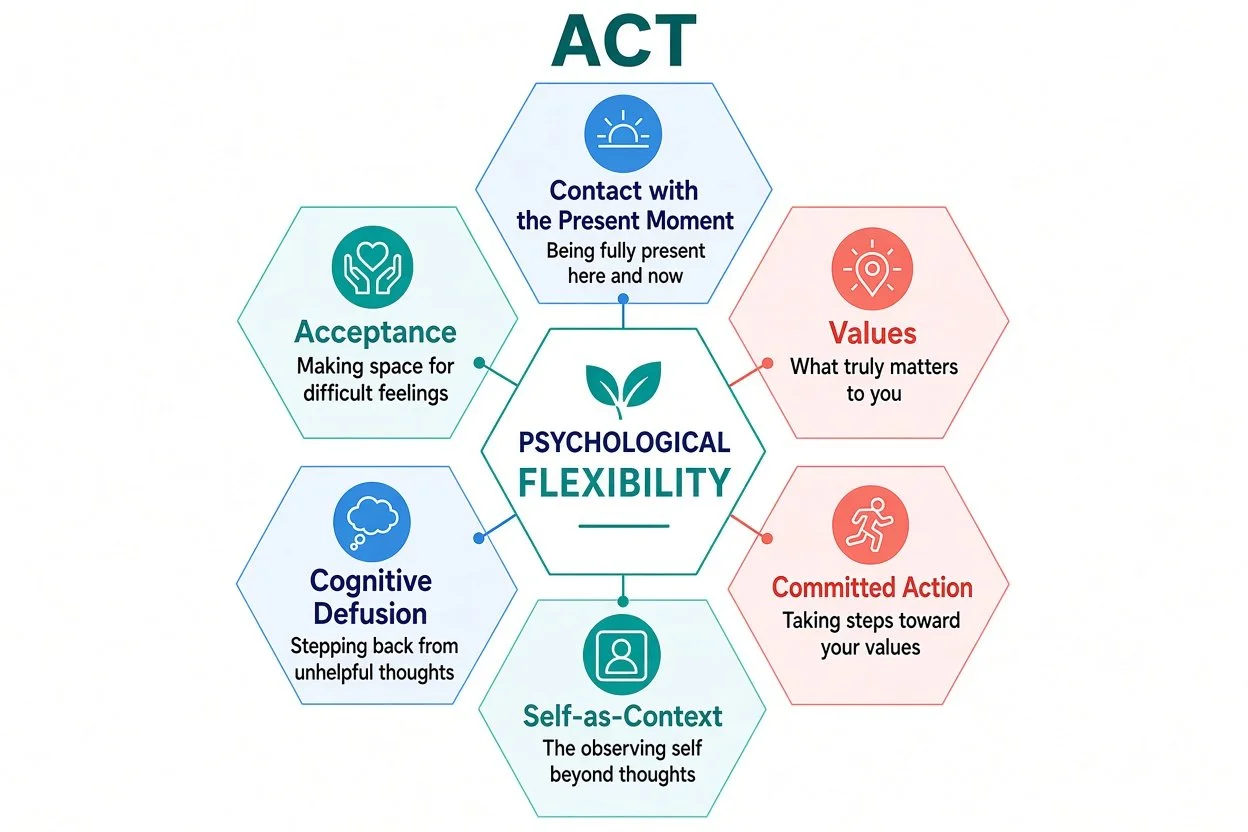
Acceptance and Commitment Therapy (ACT) is part of the newer generation of cognitive behavioural therapies. It builds on the foundation of traditional CBT while taking a different approach to the role of thoughts and emotions.
Traditional CBT often focuses on identifying and changing unhelpful thoughts. ACT takes this a step further. Rather than asking, “How can I change this thought?”, we might ask, “What happens when I believe this thought, and do I need to let it determine what I do?”
The goal isn’t to win an argument with your mind or eliminate difficult emotions. It’s to develop more flexibility in how you respond to them. You can learn to notice thoughts without automatically following them, make room for difficult feelings, and choose actions that reflect what matters to you.
This approach can be particularly useful when you already understand your patterns intellectually but still find yourself repeating them. ACT focuses less on controlling your internal experience and more on helping you have the freedom to respond differently.
Ultimately, therapy isn’t about becoming someone who never feels anxious, angry, sad, or uncertain. It’s about becoming less limited by those experiences—and building a life that is more consistent with who you want to be.

Somatic Experiencing®
“Somatic” simply means relating to the body. Our experiences don’t just show up in our thoughts and emotions—they can also be felt physically through tension, restlessness, numbness, a racing heart, shallow breathing, feeling on edge, or feeling disconnected from yourself.
Somatic Experiencing (SE) brings attention to these physical experiences as part of the therapeutic process. We slow things down and notice what is happening in your body, moment by moment, rather than relying entirely on talking things through or trying to think your way out of a problem.
A focus of this work is nervous system regulation—developing a greater capacity to recognize when your system is becoming activated, overwhelmed, or shut down, and learning ways to move toward a greater sense of steadiness and choice. My approach is also informed by polyvagal theory, which offers a framework for understanding how our nervous system responds to cues of safety, threat, and connection.
SE can be particularly helpful when you understand what is happening intellectually, but still find yourself reacting in ways you don’t fully understand or control. By becoming more aware of these patterns in the body, we can begin to develop new ways of responding.
I am currently completing advanced training in SE and expect to complete the training in November 2026.

Emotion Focused Therapy
Emotionally Focused Therapy (EFT) is based on the idea that emotions are not simply reactions to what happens around us—they organize how we perceive situations, protect ourselves, and relate to other people.
A central part of EFT is learning to distinguish between secondary and primary emotions. Secondary emotions are often the emotions that show up first and are easiest to recognize: anger, frustration, defensiveness, withdrawal, or resentment. Primary emotions tend to be more vulnerable and are often less immediately accessible—hurt, fear, loneliness, shame, grief, or a longing to feel valued and secure.
For example, anger may be protecting hurt. Withdrawal may be protecting a fear of rejection. Criticism may be an attempt to reach someone who feels emotionally out of reach.
In individual therapy, we can explore these patterns to understand what your emotional responses are trying to accomplish and what may be underneath them. Rather than simply managing emotions, the work is about developing a clearer, more flexible relationship with your emotional experience.
In couples therapy, we look at how these patterns become part of a cycle between partners. One person pursues, the other withdraws; one becomes critical, the other becomes defensive. Beneath the cycle are often deeper questions about attachment: Can I reach you? Do I matter to you? Are you there when I need you?
EFT helps couples slow these cycles down, access the underlying emotions and needs, and create new ways of responding to one another. The goal isn't simply better communication. It is a more secure and responsive connection.